Samantha Connor | Online Learning for Teachers pursuing Continuing Education and Professional Development | The Connecting Link


Samantha Connor

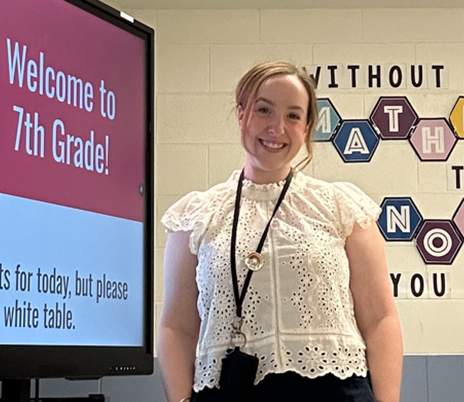
Instructor photo

Samantha is currently a 7th grade math teacher at Randolph Community Middle School in Randolph, MA. Sam started her career during the pandemic where she taught all levels of middle school math and 8th grade English Language Arts. From there, she taught 6th grade math in the bilingual program and 7th grade math in the honors academy program in her hometown of Brockton, MA. In her current position, Sam co-teaches with a special education teacher to support students with a variety of learning disabilities, and she teaches all levels of multilingual learners. Her passion is creating engaging lessons through applying Building Thinking Classroom principles and facilitating project-based learning. Sam loves adjusting and improving her teaching practices by applying feedback from her coaches and colleagues and staying up to date on educational research. She took several TCL courses as a student before becoming an instructor and always found that the courses were relevant and helpful in improving her teaching practices.

She has a Master of Arts in Teaching with a Mathematics concentration and a Bachelor of Science in Mathematics with a Secondary Education concentration from Bridgewater State University.

In her free time, she enjoys reading, pottery, and spending time at Newfound Lake in NH.

Participants in this course will examine methodologies to facilitate the development of a mathematical mindset centered around the research of Dr. Carol Dweck’s mindset theory, Dr. Jo Boaler’s classroom approach, and Dr. Susan Johnston-Wilder’s international research in math anxiety components. Participants will reflect on their own teaching practices and explore strategies and frameworks that incorporate a student’s mathematical experience and evolution. The foundations of developing a mathematical mindset will be researched. Strategies for helping students, teachers, and parents understand what a mathematical mindset is and how it is effectively implemented by reducing math anxiety will be explored. Participants will learn how to create a welcoming, yet challenging mathematic classroom experience, implement strategies/best-practices to foster a mathematical mindset for their students. Participants will learn that math stress/anxiety reducing strategies in one’s classroom and helping students understand their anxieties can improve their internal motivation. Additional topics in the course are effective lesson planning to combat math anxiety to grow mathematical mindsets, explore online/digital resources to support mathematic classroom needs, including students with special needs, and making meaningful connections with parents to strength and preserve the mathematical mindset at home.
Course #: IMW27020
Dates: 01/04/27 - 01/31/27
Categories:

Instructional Strategies Content-Area Teaching Mathematics

Format:

Interactive

View Course
Homework looks different in a world where students can turn to generative AI for answers, ideas, and even completed assignments. The course examines approaches to creating assignments that place authentic student thinking and learning at the center. Participants will consider where traditional homework practices may need to evolve, examine how students are using AI when completing assignments, and develop approaches that emphasize authentic reasoning, process evidence, local context, and meaningful connections to classroom learning. Drawing on guidance from the U.S. Department of Education’s Office of Educational Technology (2023), UNESCO’s Guidance for Generative AI in Education and Research (2023), research on AI detection limits and bias (including Liang et al., 2023, and Weber-Wulff et al., 2023), and academic integrity recommendations from the European Network for Academic Integrity (Foltynek et al., 2023), educators will learn to evaluate detection tools carefully, select AI supports that scaffold rather than replace thinking, write clear homework policies, and partner with families to create consistent expectations for AI use. After completing this course, participants will be prepared to implement a coherent, classroom-ready plan for authentic homework, responsible AI use, and family communication tailored to their unique school context.
Course #: IMW27021
Dates: 01/04/27 - 01/31/27
Categories:

Technology Tools for the Classroom Instructional Strategies Content-Area Teaching

Format:

Interactive

View Course
This course is designed to support educators with practical tools to deliver feedback that promotes student growth while addressing the often-overlooked impact of perfectionism in the classroom. Participants will examine how different types of feedback can either hinder or empower learning (Schunk & Ertmer, 2025) and explore strategies for fostering a classroom culture that encourages risk-taking, resilience, and self-confidence (Reid, 2025; McCabe, 2024). Through research-based practices and real-world examples, teachers will learn to recognize signs of perfectionism and intervene in ways that support healthier learning mindsets (Ganimian, Fryer, & Dweck, 2022). The course prepares educators to craft feedback that motivates rather than discourages, shifting the focus from flawless performance to meaningful progress (FeedbackFruits, 2023; Xu, Chen, & Zhao, 2023). Participants will engage in reflective practice, collaborative discussions, and the development of actionable plans tailored to their own teaching contexts. Ultimately, this course equips educators to create inclusive, growth-centered environments where all students can thrive.
Course #: IMW27022
Dates: 02/01/27 - 02/28/27
Categories:

Social & Emotional Learning Positive Classroom Management Content-Area Teaching

Format:

Interactive

View Course
This course provides participants with a solid framework for planning, implementing and maintaining successful co-teaching relationships that improve the learning instruction of all students. Participants will reflect on the definition of co-teaching, components of the co-teaching relationship, examine a variety of co-teaching models and how they support student learning, and evaluate their current co-teaching programs. Participants will leave the course knowing several co-teaching practices between general and special education teachers, as well as, between two general education teachers in the same classroom, and how to effectively work as a co-teaching partner to create opportunities for success for all learners.
Course #: IMW27023
Dates: 02/01/27 - 02/28/27
Categories:

21st-Century Teaching Instructional Strategies

Format:

Interactive

View Course
This course is designed to equip educators with the tools and understanding necessary for building an intentional and positive classroom culture. Participants will explore how physical environment, routines, and strategic grouping can create conditions for every student to succeed. Educators will also examine evidence-based approaches to positive behavior systems, learn strategies for responding to challenging behaviors, and develop skills to foster student ownership and responsibility. Drawing on research from Dr. Sara Rimm-Kaufman, Dr. Natalie Wilkins, Dr. Jorge Verlenden, Dr. Leigh Szucs, and Dr. Michelle Johns, this course also addresses the foundational principles behind classroom culture and why intentional design matters. After completing this course, participants will be prepared to design and implement a personalized, sustainable plan tailored to building a positive culture in their unique classroom context.
Course #: IMW27024
Dates: 03/01/27 - 03/29/27
Categories:

Social & Emotional Learning Positive Classroom Management

Format:

Interactive

View Course
Differentiation doesn’t have to mean creating multiple lessons, adding hours to your planning, or trying to meet every student need at once. This course focuses on practical, manageable ways to make small shifts in instruction that can have a meaningful impact. Participants will explore what differentiation can look like in a real classroom, unpack common misconceptions, and consider how student readiness, interests, and learning needs can guide everyday instructional choices. Drawing on Dr. Carol Ann Tomlinson’s differentiation framework (including Tomlinson & Imbeau, 2023), Universal Design for Learning connections from CAST’s UDL Guidelines 3.0 (2024), and contemporary research on differentiated instruction and teacher professional development (including recent meta-analyses and reviews such as Kahmann et al., 2022, and Langelaan et al., 2024), educators will learn to adjust content, process, and assessment through scaffolds, flexible grouping, and formative checks. Technology and applications for differentiation will also be explored, including educator AI tools that reduce repetitive work. After completing this course, participants will be prepared to implement a personalized, sustainable differentiation plan tailored to their unique classroom needs.
Course #: IMW27025
Dates: 03/01/27 - 03/29/27
Categories:

Positive Classroom Management Instructional Strategies Content-Area Teaching

Format:

Interactive

View Course
Participants in this course will examine collaborative, engaged, cooperative learning—a significant shift away from the typical teacher-centered classroom. Participants will learn how developing a classroom culture of trust, safety, challenge, and joy can foster engaged and effective learning. Research suggests that effective communication and collaboration are essential to becoming a successful learner. Participants will learn how to develop classroom learning experiences around students’ constructing knowledge and engaging in action together. Techniques to develop intrinsic motivation that leads to student engagement and achievement will be researched. Foundational work in this course will include the research and use of collaborative learning, engaged learning, and cooperative learning models. Participants will synthesize these paradigms and create applications for implementation into their own classrooms.
Course #: IMW27026
Dates: 04/05/27 - 05/02/27
Categories:

Positive Classroom Management Instructional Strategies

Format:

Interactive

View Course
Poverty, suicide, abuse, divorce, and community violence are some of the many traumatic, yet common, life experiences and events students of today’s society face. In addition, factors including social media and high stakes testing have been linked to the increasing rates of stress and anxiety among youth. This insightful course provides practical applications on how to understand, connect with, and accommodate students and their families experiencing the adverse effects of trauma, stress, and anxiety. Participants will research the short and long-term outcomes associated with adverse childhood experiences (ACEs), learn how to incorporate effective trauma-informed practices, and build relationships with students and their families based on respect, trust, and empathy. Post-traumatic stress disorder (PTSD), stress management, suicide prevention awareness, students living in poverty, and educational procedures used to respond to traumatic events are additional topics accentuated in this course. Finally, educators will focus on their own well-being and discover ways to strengthen resilience and manage stress and anxiety associated with the soaring demands of the profession. Course participants will become better equipped to effectively respond to students’ complex needs.
Course #: IMW27027
Dates: 04/05/27 - 05/02/27
Categories:

Social & Emotional Learning Positive Classroom Management

Format:

Interactive

View Course